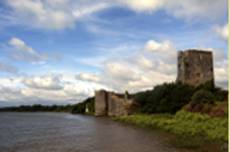
St. Mullins
St. Moling Bishop of Ferns 632 A.D.: 4
churches. Burial place of Kavanagh's, Kings of Leinster and Art Mac Murrough
Kavanagh, who was poisoned at Ross. Also St. Moling's well, a large Norman Motte
and remains of a round tower.
A Slí na Sláinte map board, located
outside the graveyard wall advises a walking route providing opportunities to
see river and woodland wildlife.
Towards the river, lies the remains of
an old flour mill. The tow path runs up river to Graiguenamangh. St.
Mullins lock gates, lock house, and island draw-bridge are on the way to Bahana
wood. After the weir, an 18th century lime kiln marks a right turn in the
Slí na Sláinte to Bahana Wood.
.
The picturesque
village of St. Mullins in South Carlow is a scenic and charming Barrow-side
village with an impressive ecclesiastical history. Nestling between the
Blackstairs Mountains on one side and Brandon Hill on the other, the
locality acquired its name from St. Moling, a 7th century cleric,
prince, poet, artist and artisan, who built a monastery here with the help
of "Gobban Saor", the legendary Irish builder. In the 8th century
manuscript, known as “The Book of Mulling”, there is a plan of the monastery
– the earliest known plan of an Irish monastery – which shows four crosses
inside and eight crosses outside the circular monastic wall. It is said that
St. Moling dug a mile-long watercourse with his own hands to power his mill
– a task that took seven years! He became Bishop of Ferns, died in 697 and
is buried at St. Mullin’s.
What to see and do
The St. Moling watercourse is still there, but the original monastery was
plundered by the Vikings in 951 and was again burned in 1138. An abbey was
built on the site later, in the Middle Ages. A 9th century High Cross,
depicting the Crucifixion and the Celtic spiral pattern, stands outside the
remains of the abbey and there are also some domestic medieval buildings,
including one that has an unusual diamond-shaped window. St. Moling's Mill
and Well are a short distance away.
Another notable monument in the packed little churchyard is a penal altar,
used in the days when the anti-Catholic penal laws were in force. A Norman
motte, once topped by a wooden castle, stands outside the churchyard, and
when Mass was being said at the altar some of the congregation would climb
the motte to act as lookouts.
The MacMurrough Kavanaghs, former Kings of Leinster, together with other
Celtic Kings, are buried in the precincts of the monastery. Fr. Daniel
Kavanagh, who is said to have had the gift of healing, is also buried here.
People still claim that to cure toothache you should take a pinch of earth
from outside the churchyard and exchange it for a pinch of clay from F.
Kavanagh's grave. Then say a brief prayer, pop the clay into your mouth and
walk down the hill to wash it out with water from St. Molings Well.
The complex includes a medieval church ruin, the base of a round tower and
the former Church of Ireland church, built in 1811. Protestants and
Catholics lie side by side in the churchyard, and a story is told in the
village of the days when, because there were only a handful of Protestants
in the neighbourhood, the local Church of Ireland Bishop was thinking of
closing down the church. The distraught vicar had a word with the Catholic
priest, who had a word with his flock, and on the day of the Bishop’s visit
Catholic families filled the Protestant church, joining in the responses and
lustily singing Protestant hymns. The Bishop went home delighted and the
church remained open!
The church was acquired by St. Mullins Mhuitir na Tire for use as a heritage
centre in 1986. All aspects of local history including publications, church
records, maps, old photographs and small artefacts are on display here.
(A most interesting and informative tour of the settlement is available by
contacting 051 - 424913)
As well as being a good spot for anglers, St. Mullins is one of the
stop-off points for the many pleasure
barges/cruisers who ply the River Barrow. The building of the canal
system of lock system on the river began here in 1750.
St. Mullins is also the starting/finishing point of the
Barrow
Way long distance waymarked way or for visitors who prefer a shorter
walk, enjoy the 6Km Sli na Slainte route which commences outside the
graveyard, passes through
Bahana
Wood and returns via Templenabo to the village.